
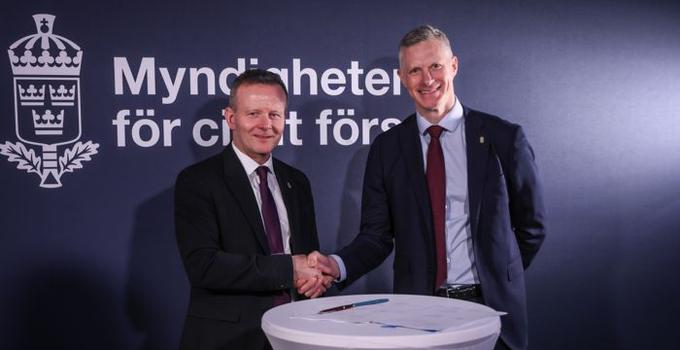
Mikael Frisell (left), Director General of the Swedish Civil Defence and Resilience Agency, and Robert Egnell, Vice-Chancellor of the Swedish Defence University, sign the agreement on funding for the research environment in leadership and cooperation for civil defence. Photo: Niclas Kindahl.
SEK 25 million for research on leadership and cooperation in civil defence
The Swedish Defence University is receiving long-term funding to strengthen research on leadership and cooperation within civil defence. The Swedish Civil Defence and Resilience Agency is awarding SEK 25 million for the development of the research environment.
On 15 January, the Swedish Civil Defence and Resilience Agency and the Swedish Defence University signed an agreement on funding for the research environment Leadership and Coordination for Civil Defence (LedSamCF). The initiative totals SEK 32.5 million over the period 2026–2030, with the Swedish Defence University co-funding SEK 7.5 million.
“This initiative means that, in close collaboration with the Swedish Civil Defence and Resilience Agency, we will have the opportunity to strengthen practice-oriented research that can deliver both immediate and long-term effects for the capability of civil defence”, says Robert Egnell, Vice-Chancellor of the Swedish Defence University.
“The aim of this initiative is to enhance the importance of research for the development of civil defence. It is also fully in line with our ambition to work through strategic partnerships with selected research and innovation actors”, says Mikael Frisell, Director General of the Swedish Civil Defence and Resilience Agency.
Emergency preparedness and civil defence
The research environment will build and develop knowledge on how leadership, coordination and governance within civil defence can function in practice, ranging from everyday emergency preparedness to the demands of war. The research focuses on a civil defence system characterised by multiple actors, differing responsibilities and diverse regulatory frameworks.
“Civil defence faces complex challenges. Our research will contribute knowledge that is both scientifically grounded and directly usable for those who lead and coordinate society’s preparedness”, says Aida Alvinius, Professor of Leadership and Command & Control and head of the research environment at the Swedish Defence University.
Three themes in focus
The research environment brings together researchers from several disciplines and is organised around three integrated themes:
- the design of leadership and coordination systems;
- legal and administrative structures; and
- organisational and social processes within civil defence.
Together, these perspectives aim to strengthen the capacity to manage simultaneous crises, grey-zone challenges and the threat of war in a legally sound, effective and socially sustainable manner.
“We want to understand what actually works when many actors have to act together under intense time pressure and uncertainty. This ranges from legal frameworks to trust, technology and practical coordination”, says Aida Alvinius.
Close links to practice
The research environment will work in close dialogue with authorities, municipalities, regions, the business sector and civil society. Results will be disseminated through academic publications, policy recommendations, education and exercises.
The long-term goal is for the environment to become a national knowledge hub for research, education and analytical support in the field of civil defence.
“Through this initiative, we can build long-term research structures that strengthen Sweden’s civil defence, not only in theory but in practical application”, says Aida Alvinius.
Work to establish the research environment at the Swedish Defence University will begin on 1 February and will be carried out in three stages.
“During the first year, we will build up the environment and establish research methods. In years two to four, we will collect data and develop various solutions, and in the fifth year we will compile results, tools and recommendations”, says Aida Alvinius.
Page information
- Published:
- 2026-01-19
- Last updated:
- 2026-01-19