

Photo: Archive
Law clinic brings legal studies closer to practice
Students in the master’s programme International Operational Law have taken their legal knowledge beyond the classroom through a new law clinic. Working with the IHL Centre, they have researched legal questions arising from the practical application of international humanitarian law in conflict settings.
During the 2025–2026 academic year, the Swedish Defence University piloted a law clinic as an extracurricular activity for students in the master’s programme in International Operational Law. A law clinic is a hands-on approach to legal education in which students work with an external organisation on legal questions drawn from its activities. In this pilot, students collaborated with the IHL Centre, the centre of legal expertise that is part of the Swedish development organisation Diakonia.
Working in small teams, the students researched questions identified by the IHL Centre through its work in Jerusalem and East and Central Africa. At the end of the project, the teams delivered two legal research reports to the Centre.
“The pilot takes what students have learned in the classroom and builds on it through research questions identified by practitioners. It is also an example of how collaboration between the Swedish Defence University and civil society can contribute to wider societal insights and research”, says Yiokasti Mouratidi, project coordinator and doctoral student at the Department of International and Operational Law at the Swedish Defence University.
Applying legal knowledge to real-world questions
The students have been responsible for framing their research questions, identifying and analysing relevant legal sources and drafting the reports. They have also met with legal experts at the IHL Centre to discuss their research.
For Nathalie Engwall, who graduated from the LLM Programme in International Operational Law in 2026, the clinic offered an opportunity to see how academic knowledge can be used outside the university.
“The Law Clinic provided a valuable opportunity to apply legal research skills to a real-world project. It allowed me to move beyond purely academic discussions and engage directly with practical legal research”, she says.
Nathalie Engwall worked on a project examining the obligation to take constant care during military operations. Her team analysed sources including treaty law, state practice, military manuals, case law and academic literature.
“The experience gave me a better understanding of how collaborative legal research is conducted in professional settings and of the importance of balancing academic rigour with practical relevance”, she says.
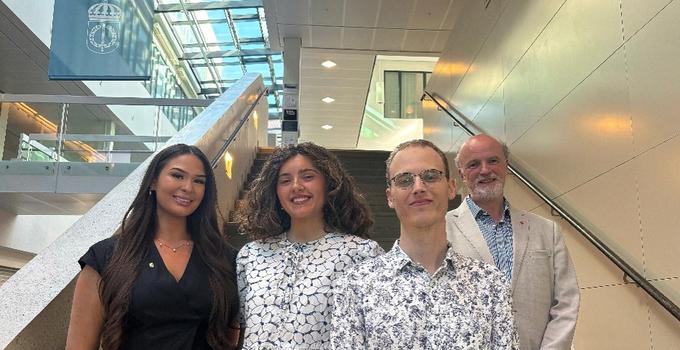
Left to right: Nathalie Engwall, Hanna Folkunger, Jack Andersson and David Turns, Senior Lecturer at the Department of International and Operational Law. Photo: Private
Collaboration an important part of the experience
For fellow graduate Hanna Folkunger, working as part of a team proved to be one of the most valuable aspects of the project.
“I initially expected the legal knowledge gained through our research to be the most valuable part. But developing my ability to collaborate effectively as part of a team was just as important”, she says.
The research also required the students to work with legal questions where relevant sources could be limited or indirect.
“Collaborating on complex legal questions and collectively developing well-reasoned solutions strengthened both my legal analytical skills and my ability to approach difficult problems from different perspectives”, Hanna Folkunger says.
According to Yiokasti Mouratidi, the IHL Centre also sees value in bringing academic research and practical legal work closer together. The students contributed additional research capacity and new perspectives on legal questions arising from the Centre’s work in conflict-affected contexts. The pilot also demonstrated how this type of collaboration can help bridge the gap between academic research and the practical application of international humanitarian law in conflict zones.
Pilot to continue
The first year has also allowed the Swedish Defence University to test how a law clinic can be incorporated alongside the regular master’s programme, including supervision, student workload and collaboration with an external partner. The experience will now be used to further develop the model. The law clinic is planned to continue with the next group of LLM students.
“This first pilot has given us a structure that we can continue to improve. The students have put a great deal of work into the project, and their feedback has also helped us identify both its strengths and areas for development”, says Yiokasti Mouratidi.
Page information
- Published:
- 2026-09-21
- Last updated:
- 2026-09-21