
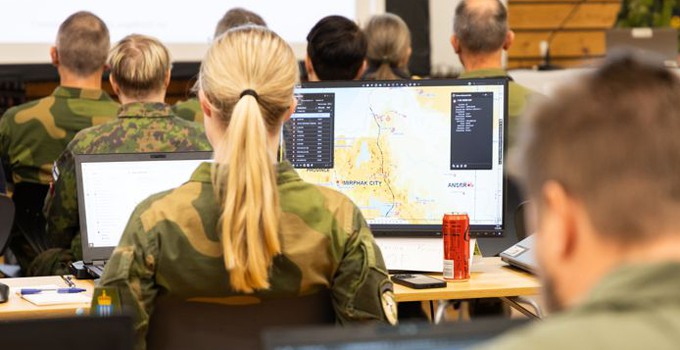
Students at the master’s programme in military studies at the Norwegian Defence University College. Photo: Ella Hagen/Forsvaret
AI tested in military operational planning exercise
How does AI impact military planning and education? That was the central question when the Swedish Defence University (SEDU), together with its Norwegian counterpart, the Norwegian Defence University College (NDUC), conducted an experiment during the exercise Comprehensive Shield 2025.
“This was the first time we jointly tested an AI-based decision support system during a military planning exercise. The aim was to explore how AI affects the planning process itself, as well as how participants perceive the tool and its educational value", says Lieutenant Colonel Peter Bovet Emanuel, PhD in War Studies and military teacher at the Swedish Defence University.
The decision support system was tested during the military field and staff exercise Comprehensive Shield 2025, held at the Kjevik Leir base in Norway in June 2025. The exercise is part of NDUC’s master’s programme in military studies, where students take on realistic roles in a headquarters environment and practise planning, decision-making, and cooperation in a complex setting over three weeks.
Three methods put to the test
Three planning teams worked on the same military scenario but with different methods. One group used traditional NATO planning without AI, another used the same method but with AI support, and the third employed an alternative approach combining systems thinking and design methodology—also supported by AI.
The results showed that AI can yield positive effects, such as increased creativity, better decision-making support, reduced mental workload, and new ways of thinking about planning. However, there are also challenges.
“To use AI effectively, a certain level of technical understanding is needed, along with a willingness to adjust how work is distributed within the team. It’s no magic solution, but in this case, it proved to be a powerful methodological and planning tool when used properly", says Peter Bovet Emanuel.
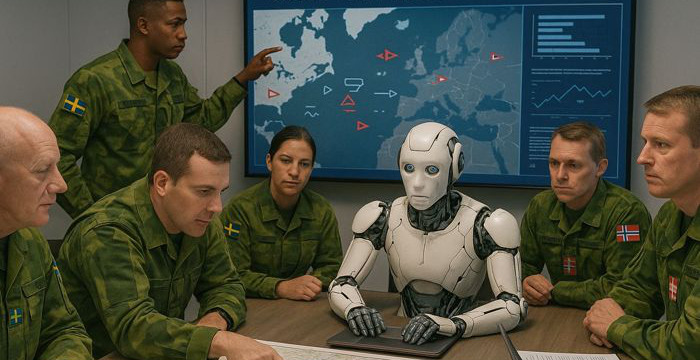
Image created by ChatGPT with the instruction: Create a futuristic picture showing a military staff exercise where participants explore human-machine teaming in joint operational planning. Participants wear Swedish and Norwegian field uniforms.
Different uses of AI
One key insight was that the teams used AI in different ways. The team following the NATO planning method used AI continuously and found that the tool gradually contributed to deeper insights into the problem, less cognitive strain, and better decision-making support. In contrast, the team using design methodology used AI to a lesser extent, mainly because the format of the tool was not designed to fit that method and therefore did not align as well with their way of thinking.
“This indicates that today’s AI-integrated decision support systems remain relatively specialised and may not be equally suitable for all types of planning or methodologies", explains Peter Bovet Emanuel.
Contributing to ongoing development
The experiment was carried out without disrupting the ongoing exercise, demonstrating that similar studies can be integrated into complex military environments. It also provided important insights for future collaboration in military education across the Nordic region, and for NATO’s ongoing development of AI-related concepts and guidance.
“This is not just an exploratory effort to assess the educational value of AI or future leaders’ attitudes to new technology, it’s also an important step in understanding how AI can be used in real defence contexts. This first joint AI experiment also lays the foundation for continued research between the two institutions, and likely future joint publications", says Peter Bovet Emanuel.
“This work is a significant step forward on several fronts. The research was carried out in collaboration with our Norwegian NATO colleagues, focused on a core element of senior officer competence, and explored how we can benefit from emerging AI technologies. I look forward to continued cooperation and development in this important area", says Anders Palmgren, who was Director of the Joint Advanced Command and Staff Programme (HOP) at the Swedish Defence University during the experiment and is now Director of the Institute for Warfare.
Page information
- Published:
- 2025-10-08
- Last updated:
- 2026-04-21