
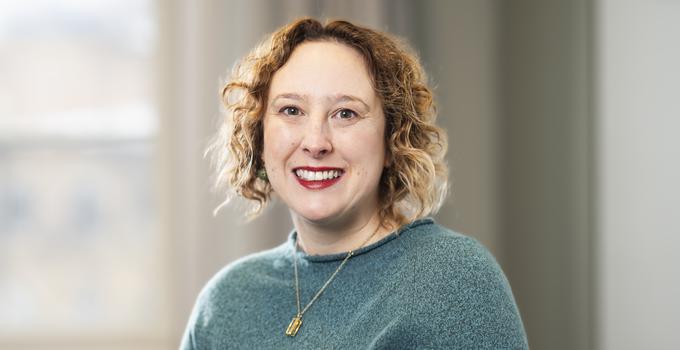
Victoria Basham, Professor of International Relations at Cardiff University. Photo: Linnea Bengtsson
Understanding war beyond the battlefield
For more than 20 years, Victoria Basham has studied how societies prepare for war and how people make sense of that preparation in their everyday lives. Her research moves beyond strategy and doctrine, focusing instead on lived experience, identity and meaning.
“I’ve always been interested in how war is understood, not just by states or militaries, but by the people who live with its consequences”, says Victoria Basham, Professor of International Relations at Cardiff University and the 2026 holder of the Kerstin Hesselgren visiting professorship at the Swedish Defence University.
Basham’s work examines how militaries, states and societies prepare for war, and how these processes are shaped by social identities such as race, class, gender and sexuality. Early in her career, during her doctoral studies in the early to mid-2000s, she spent extensive time on military bases, conducting interviews and observations and, as she puts it, “generally hanging out with soldiers, sailors, Royal Marines, and airmen and airwomen”.
“I immersed myself in military spaces as much as a civilian researcher can, that was the only way to really understand how military culture works from the inside”, she explains.
That immersion occasionally led to unexpected situations.
“I once learned how to navigate my way out of a minefield”, she recalls.
“It’s a skill I very much hope I never have to use again.”
How reforms reshape military culture
Her fieldwork coincided with a period of major change in the UK armed forces, including the disbanding of all-women corps, the lifting of the ban on non-heterosexuals serving, and efforts to recruit and retain more ethnic minority personnel. Basham’s research explored how these reforms reshaped military culture and everyday life from the perspective of those serving.
“These policy changes weren’t just abstract decisions. They affected how people lived, worked and understood themselves within the armed forces”, she says.
Through this work, Basham also gained broader insight into how military personnel understand war itself, and how armed forces relate to the societies they serve. In recent years, her focus has expanded further to include public understandings of war, military activity, and other forms of violence such as terrorism and disasters.
Personal history shaped her research on war
Her interest in war and violence has deep personal roots. Growing up, war was a constant but indirect presence. Her mother worked caring for elderly people, many of whom had lived through the Second World War and shared stories of fighting, displacement, rationing and life on the home front.
“As a child, I found those stories fascinating. They made war feel both distant and very close at the same time”, Basham says.
Conflict also shaped her own family history. Her grandmother grew up in Ardoyne in Belfast but left the city in the early 1950s to escape increasingly hostile conditions. Ardoyne later became one of the deadliest areas during the Troubles.
“In my family, the Troubles meant that neither politics nor religion were discussed at the dinner table. Perhaps inevitably, that made me want to understand more”, Basham says.
Another formative influence was the story of her great-aunt Sarah, who was imprisoned for two months in the 1960s for taking part in a sit-down protest against nuclear weapons with the Committee of 100 – a pivotal organisation in the history of the British peace movement. Basham is now researching the Committee of 100 for an upcoming book project.
Methodologically, Basham uses qualitative approaches that allow her to build rich, detailed accounts of how people interpret their experiences. She combines interviews, focus groups and long-term observation with archival research and analysis of social media and public narratives.
“I use the methods that help me build the fullest picture possible. I’m interested in how people themselves give meaning to what they’ve lived through”, she says.
Hooked on research from the start
Basham’s path into academia began early. She loved school and became the first person in her family to attend university. Once there, she quickly became drawn to research and was encouraged by a supportive lecturer to pursue a PhD.
“I really enjoyed the research, and the teaching I did alongside it. After that, I couldn’t imagine doing anything other than being an academic.”
Following her doctorate, she held a funded postdoctoral fellowship that took her to York University in Toronto and the University of Bristol. She secured her first lectureship at the University of Exeter in 2009, moved to Cardiff University in 2016, and was promoted to full professor in 2021.
Looking ahead, Basham emphasises that academic research is always a collective effort.
“To understand something as complex as war and violence, we need many perspectives and as much evidence as possible. My hope is that I contribute something valuable to that larger patchwork.”
She is also deeply committed to supporting others’ research, through teaching, mentoring, editorial work and her role as Vice Chair of the British International Studies Association.
Strengthening ties with Swedish scholars
As the 2026 Kerstin Hesselgren Visiting Professor, Basham plans to build long-term collaborations with scholars in Sweden and to support the research already underway at the Swedish Defence University.
“I’m hoping to develop joint grant projects, explore co-authorship, and work closely with early career researchers”, she says.
She will also move the journal Critical Military Studies, which she co-founded and currently edits, to the Swedish Defence University.
“There are leading scholars here who are doing incredibly important work on how military power and conflict shape our world” she notes.
Finally, Basham sees the visiting professorship as an opportunity for reflection.
“I’m really looking forward to learning more about Kerstin Hesselgren’s work and how her significant contributions to international affairs and peace might inform my own work.”
In brief
Current: The 2026 holder of the Kerstin Hesselgren guest professorship at the Swedish Defence University
Leisure activities: ”I love reading, swimming, playing board games, and cooking.”
Most recently read book: The Wind-Up Bird Chronicle by Haruki Murakami. “I spent last October in Japan and love Japanese culture.”
Hidden talent: ”I'm told I have some good moves on the dance floor.”
Happy to discuss: ”Local tips for things to do and places to go in Stockholm and wider Sweden! As I've just moved here, any recommendations will be gratefully received.”
My driving force as a researcher: “My curiosity and hope for a more equal and less-violent world drive me in a broader sense but day-to-to day, it's collaborating with others and sharing ideas. I find co-authoring exhilarating because what you produce is always more than the sum of its parts!”
More about the visiting professorships
Kerstin Hesselgren's and Olof Palme's visiting professorships to the Swedish Defence University
Page information
- Published:
- 2026-01-29
- Last updated:
- 2026-03-30