
Photo: Linnea Bengtsson
How international law can make a difference
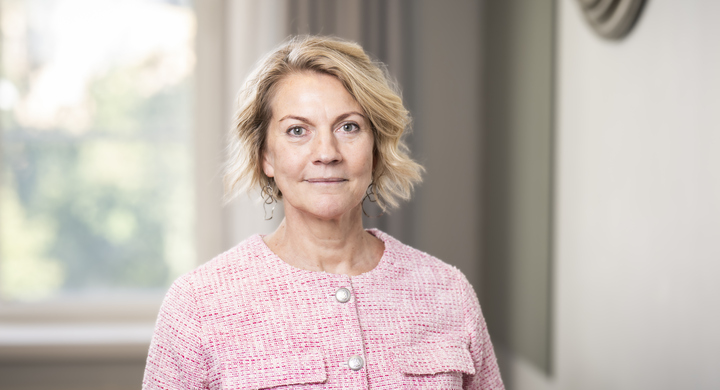
After nearly 30 years in international conflict zones, Annette Lyth has stepped into the classroom at the Swedish Defence University. Drawing on experience from places such as Afghanistan and Rwanda, she now teaches international law, aiming to provide students with both practical tools and a sense of hope in an uncertain time.
In August 2025, Annette Lyth took up her position as a lecturer at the Centre for International and Operational Law at the Swedish Defence University . She brings with her experience from countries including Afghanistan, Iraq, Rwanda and Ukraine, where she served as a legal adviser focusing on human rights and humanitarian law.
Working at the Swedish Defence University means a new context and a different perspective compared to fieldwork, yet those experiences continue to guide her work.
“Previously, my focus was often on the consequences of conflict: rebuilding societies, documenting abuses and supporting victims of, for example, conflict-related sexual violence”, she explains.
Now, the emphasis is more on engaging earlier in discussions—particularly those related to planning and decision-making processes, not least within the military, but also within public authorities operating under Swedish legislation.
New types of discussions and perspectives
As an example, she highlights the ongoing debate on landmines. After conflicts, mines are a common cause of civilian injury, especially among children who come across unexploded ordnance. At the same time, in military planning, mines may be viewed as a means of stopping attacks and protecting areas. Understanding the differences between types of mines, how they are used, and considering multiple perspectives has become an important part of her learning at the Swedish Defence University. It also raises new questions within her research, such as who is actually considered a responsible actor under international law.
“Traditionally, states and military organisations carry formal responsibility, but work on landmines reveals how much more complex that picture is in practice”, says Annette Lyth.
It is often civilian actors - local organisations, journalists, healthcare professionals and individual witnesses - who first observe and document the real consequences for affected populations. Yet they are rarely involved when rules are interpreted and decisions are made.
“This creates a gap: legal frameworks are often developed and applied without the knowledge held closest to those affected. My research therefore focuses not only on what the rules are, but on who is given the opportunity to use them.”
AI and technological developments raise new questions
Rapid technological developments, particularly in AI and increasingly autonomous weapons systems, are also raising new questions. How should existing rules be applied? Do requirements need to be tightened? Do legal frameworks need to change?
She believes such questions require multiple perspectives and open dialogue. As these discussions are still at an early stage, they are particularly well suited to the Swedish Defence University environment.
Teaching to provide hope and practical tools
When Annette Lyth meets her students, she notices that many currently view the world as bleak and that international law often becomes visible primarily when it is violated. A key part of her teaching is therefore to demonstrate that international law can also have a positive impact. Through concrete examples - such as documenting violations - it becomes clear that rules and norms can influence both behaviour and decision-making.
“Being here and teaching is a way of doing something tangible at a time that can otherwise feel dark. Individuals can influence more than we often think, and even more together. Showing how is about giving the next generation both tools and hope to carry the baton forward.”
Such practical tools include how to conduct interviews ethically and respectfully, how to protect sources, and how to handle sensitive information securely.
This knowledge has been crucial in her own work—for example, when interviewing women detained and subjected to sexual violence by IS, or documenting atrocities during the Rwandan genocide in the 1990s.
Her experience shows that professional documentation can lead to legal proceedings and accountability, but also provide recognition and a voice for those affected.
“Knowledge of rights is a powerful tool, especially when widely shared - when people organise and can hold decision-makers accountable. International law and the UN system are fundamentally created by and for people, and when awareness of the rules is widespread, society’s capacity to act is strengthened. That is something I want my students to take with them.”
Rights must be applicable in practice
In the field, reality does not always fit neatly within legal frameworks and conventions. This requires both sound judgement and the ability to interpret and apply rules in a reasonable way. Drawing on child protection frameworks, for example, Annette Lyth identified early on a need to address children’s mental health during the war in Ukraine, where she worked for UNICEF. Experiences from the invasion made the issue urgent. At the same time, these frameworks helped open discussions about mental health in a society where mistrust of psychologists- rooted in Soviet-era experiences - had long persisted.
“When you understand the legal frameworks thoroughly, it becomes easier to apply them in practice and develop work in the field. It also enables you to act in situations that do not fit predefined examples. That ability is essential and needs to be developed through real cases.”
In brief
At the Swedish Defence University since: August 2025.
Driving force: The privilege of encountering different cultures and witnessing human resilience. Meeting people who have endured unimaginable experiences yet continue to live, rebuild their lives and find strength is deeply inspiring.
In my free time: I enjoy exercising.
Most recently read book: Den dagen den sorgen by Jesper Larsson, which I read in my book club. Unfortunately, we unanimously agreed not to recommend it. Instead, I would mention The Internationalists by Oona A. Hathaway and Scott J. Shapiro, which explores how the prohibition of war came about and the individuals who helped shape international law.
Happy to discuss: Almost anything, but especially how we ended up here. I began my career in the 1990s, when the value of human rights was at its peak following the fall of the Berlin Wall and the Iron Curtain. There was widespread optimism about the future, yet today we see humanitarian law being ignored and undermined.
Hidden talent: I can cut a deck of cards with one hand and am fairly good at card games.
Page information
- Published:
- 2026-03-30
- Last updated:
- 2026-03-30