
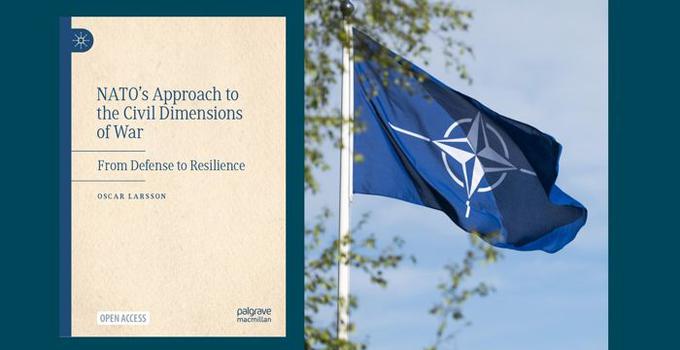
New book examines NATO's approach to civil defence over 75 years
Civil defence has been part of NATO’s deterrence since the Alliance’s early years. But views on the role of the civilian population have changed. In his new book, NATO’s Approach to the Civil Dimensions of War, Oscar Larsson traces developments from Cold War civil protection to today’s focus on resilience and hybrid threats.
What does NATO actually mean when it talks about resilience? That question was the starting point for Oscar Larsson, Associate Professor of Political Science at the Swedish Defence University. He wanted to understand how democratic states seek to address hybrid threats and what is known as the grey-zone problem – situations in which the boundary between peace and conflict is unclear.
When he began examining NATO’s use of the concept of resilience, the trail led him back through the organisation’s history. Although NATO is a military alliance, civilian resources, civil preparedness and the protection of the population have long formed part of its work.
“I noticed that there was no book examining this aspect of NATO’s history and the lesser-known Article 3 of the North Atlantic Treaty. By tracing these developments historically, we can also gain a better understanding of today’s discussion on civil defence”, says Oscar Larsson.
Civil defence is nothing new for NATO
In the book, Oscar Larsson traces the development of NATO’s work on civil defence and civil protection from the founding of the Alliance in 1949 to the present day.
One conclusion is that several issues that appear new today have a much longer history. NATO’s civilian activities were already being gradually expanded during the Cold War. In the 1960s, civilian actors were given a greater role in providing logistical support for military operations. During the 1970s, this work expanded to include disaster preparedness, civil-military cooperation and the idea that civilian resources should be available for both civilian and military purposes.
At the same time, the study reveals a recurring tension. NATO has often had high ambitions for civil preparedness, while member states have not always prioritised implementing what they have collectively agreed.
After the Cold War, greater attention was devoted to international crisis management and disaster relief. However, following Russia’s annexation of Crimea in 2014 and its full-scale invasion of Ukraine in 2022, civil defence and emergency preparedness once again assumed greater importance.
Resilience takes centre stage
Since 2016, resilience has become a central concept in NATO’s work. The seven baseline requirements for resilience cover areas including energy supplies, transport, food, communications and the ability to manage large-scale population movements.
The underlying premise is that society as a whole needs to contribute to resilience. This applies to governments and public authorities, but also to businesses, organisations and individuals.
According to Oscar Larsson, however, this new terminology does not mean that the fundamental problems are new.
“Resilience may be a modern and useful term, but the concept itself does not solve the political and economic challenges associated with civil defence and civil protection. Clear priorities, objectives and resources are still required”, he says.
Changing views of the civilian population
The book also identifies a change in how the role of the civilian population is described. Previously, the emphasis was on protecting people in wartime. In today’s approach to resilience, individuals are increasingly expected to be prepared themselves and to contribute actively to society’s preparedness.
Oscar Larsson argues that this development needs to be critically examined. Viewing people as a resource in a conflict may also create new vulnerabilities.
“I hope that the historical perspective can contribute to a more concrete discussion of civil defence and civil protection. If we talk only about resilience, there is a risk that the concept will obscure the difficult security policy issues that actually need to be addressed”, says Oscar Larsson.
Publication
Oscar Larsson (2026): NATO’s Approach to the Civil Dimensions of War – From Defense to Resilience. The book is available open access.
Read more: Resilience – a buzzword without a clear meaning in Swedish policy
Page information
- Published:
- 2026-08-25
- Last updated:
- 2026-08-25