
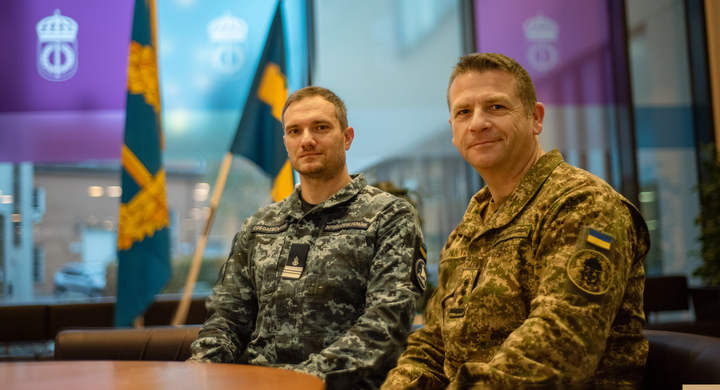
Anton Sobolevskyy, captain lieutenant in the Ukrainian Navy and Volodymyr Liutyi, colonel in the National Guard of Ukraine. Photo: Simon Ydhag.
Mutual learning between Ukrainian and Swedish officers
For five weeks, a group of Ukrainian officers have attended the course Tactics in an Operational Context alongside participants from the Joint Advanced Command and Staff Programme at the Swedish Defence University. They have received intensive training in NATO doctrines while sharing their experiences of the war in Ukraine.
Volodymyr Liutyi, 45, a colonel in the National Guard of Ukraine, and Anton Sobolevskyy, 42, a captain lieutenant in the Ukrainian Navy, are two of around 20 officers from different branches of the armed forces who have spent five weeks in Stockholm attending the course. Their military backgrounds are very different. Volodymyr Liutyi has been a career soldier for 28 years and has served in combat since 2015. Anton Sobolevskyy enlisted following Russia's full-scale invasion in 2022. He had no previous military training and had been working as a seafarer on a merchant vessel.
"I think that's why they assigned me to the navy," he says.
Understanding NATO doctrines and joint operations
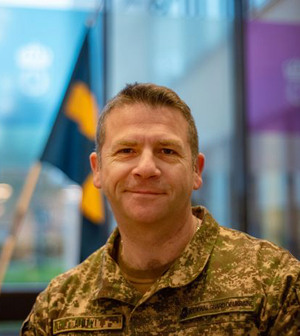
Volodymyr Liutyi, colonel.
Volodymyr Liutyi joined the course hoping to gain a better understanding of how NATO operates, particularly decision-making and operational planning at brigade and divisional level.
"These five weeks have given us a great deal of theoretical knowledge and practical skills in the planning process. We now have a better understanding of how these processes work within NATO structures," he says.
He sees clear benefits in having a common operational framework that enables military units from different nations to work together.
"What's interesting is how clear and easy to understand the procedures are when several nations are involved. That's what makes multinational cooperation possible. It's something we can take back home and try to introduce into our military training, or at least communicate to our leadership," he says.
Anton Sobolevskyy has a different perspective. He feels that the course operates at a level far above his own responsibilities.
"It's difficult for me to say what I'll take away from the course. I work at a much lower tactical level," he says.
Nevertheless, both officers feel that the course has provided valuable insights into how different combat arms operate together on the battlefield, and how the different branches of the armed forces coordinate their activities under a unified command.
"I hope all the Ukrainian officers have gained a better understanding of how the air force, navy and ground forces can coordinate and operate under a unified command. You can't, for example, deploy infantry alone without involving other capabilities, at the very least drones to provide support," says Volodymyr Liutyi.
"In that respect, the course has given me new perspectives that I can share when we plan operations back home," Anton Sobolevskyy agrees.
Bringing the realities of war into the classroom
An equally important aim of the Ukrainian officers' participation has been to share their experiences of the war.
"From the very beginning, we've shared our perspectives on what's happening on the battlefield, the advantages and disadvantages of modern warfare, and how the reality differs from military training in peacetime," says Volodymyr Liutyi.
Through exercises, war games and discussions, the Ukrainian officers have contributed practical experience that he hopes has given their Swedish counterparts a deeper understanding of the realities that military planning is ultimately intended to prepare them for.
"It's easy when you're facing a simulated enemy during an exercise. You're firing blank ammunition and nobody dies. Nobody's body is torn apart. There's no blood, no sweat, no bombs exploding around you," he says.
"I wouldn't wish the experience of being on a real battlefield on anyone. But we've tried to explain what that feels like and how profoundly it affects decision-making, whether you're a platoon commander, a battalion commander or a corps commander. When you've suddenly lost a your soldiers, something has gone wrong. Perhaps you've made the wrong decisions yourself?"
Mutual learning challenges assumptions
While the Ukrainian officers have contributed valuable combat experience, Anton Sobolevskyy emphasises that the learning has gone both ways.
"Coming here has also been a reality check for me," he says.
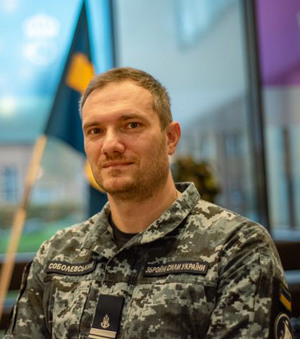
Anton Sobolevskyy, captain lieutenant.
His time in Stockholm has prompted him to reflect on why some countries are at war while others live in peace. He believes this is not simply a matter of luck, but that Sweden's defence capabilities and international cooperation play an important role in deterring potential attacks.
“I didn’t realise it myself before I came here. Now I can clearly see that we are at war because our planning was inadequate and our economy was weak, which affected the capabilities of the Ukrainian Armed Forces. Russia attacked us because our defence capabilities were not strong enough. I don’t see this as a problem for Sweden, as you are strong and wise enough to prevent that from happening.”
Cooperation beyond the classroom
Both officers also reflect on the importance of international military cooperation for Ukraine's future.
Although Anton Sobolevsky would like to see Ukraine become a member of NATO, he believes this is unlikely in the foreseeable future. He therefore sees bilateral defence agreements as particularly important.
"Even if there's a ceasefire, I'm convinced Russia will come back. And Ukraine probably won't be a member of NATO by then either. That's why agreements with other countries could be enormously helpful to us."
The mutual learning throughout the course has been appreciated by both the Swedish and Ukrainian officers.
“The participation of the Ukrainian officers has given the other officers on the course a deeper understanding of modern warfare and tactical operations, which has been valuable. This first joint training initiative was a success. We have submitted a lessons learned report to the Swedish Armed Forces to help them decide whether to continue the collaboration, which we hope they will,” says Commander Göran Walldén, military instructor at the Swedish Defence University.
Background to the exchange
The idea of inviting Ukrainian officers to participate in the course Tactics in an Operational Context was a joint initiative by the Swedish Armed Forces and the Swedish Defence University following Ukraine’s participation in AURORA 26. The Ukrainian involvement inspired the idea of a joint course in operational planning, aimed at giving Ukrainian officers the opportunity to learn about NATO planning concepts while enabling Swedish officer students to gain insights into contemporary warfare through the exchange of experiences.
Page information
- By:
- Monika Wallström
- Published:
- 2026-11-10
- Last updated:
- 2026-11-10