
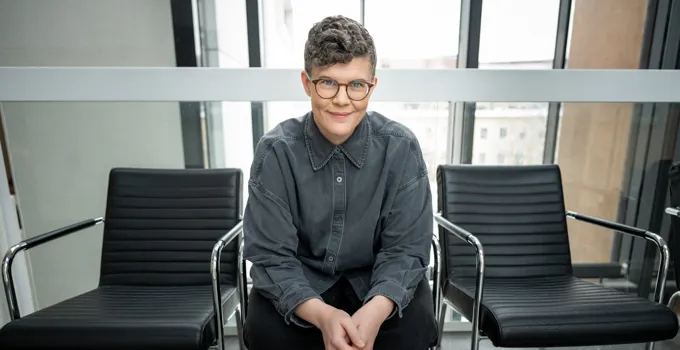
Photo: Anders G Warne
She explores the connections between war, warfare, knowledge and society
How is our understanding of war shaped, and what are its practical consequences? This is a central question for Anna Danielsson, Professor of War Studies at the Swedish Defence University since 1 October 2026. Her research examines how knowledge about war is produced and used, and what happens when cities become both targets and sites of warfare.
Knowledge about war is produced across society. Universities, armed forces, political actors, think tanks and the media all contribute to shaping perceptions of what war is and how a particular conflict should be understood. Anna Danielsson examines how this knowledge is produced and what consequences it has. This includes whose knowledge claims gain recognition and which perspectives are marginalised. These questions also have implications for how war is legitimised and justified.
“From this perspective, knowledge about war is not produced solely by military organisations and academia. Rather, knowledge is a broader social phenomenon involving a range of actors across society”, she says.
Perceptions of the city shape warfare
Her other main area of research concerns war and warfare in and against cities. This is also where her two research interests intersect: how military organisations understand and produce knowledge about cities influences how they plan and conduct urban operations.
Anna Danielsson has studied, among other things, the US military’s perceptions of the city from the mid-19th century to the present day. She examines how understandings of the urban have changed over time and what this means for military practices.
Her interest also has a personal dimension.
“I have long felt drawn to cities, to urban life and to the dynamism and energy that often characterise a city in different and sometimes contrasting ways.”
Cities have long been closely connected to defence and warfare. Historically, this can be seen, for example, in star forts, with their star-shaped walls and moats. More recently, cities have been at the centre of many wars and conflicts, from the Balkans in the 1990s to Ukraine today.
When violence targets the city itself
Another strand of her research concerns urbicide. The term describes military violence intended to “kill” a city. Anna Danielsson examines what this means for both the physical urban environment and the people who live there. To understand urban wars, research needs to encompass perspectives beyond those expressed in state accounts and military doctrines, she argues.
“We need to study people’s experiences, practices and production of meaning and knowledge in relation to urban wars, focusing both on those who train for and wage war and on the urban populations who live with its consequences.”
A longing to return to academia
Anna Danielsson’s interest in research developed through writing dissertations during her studies in Uppsala. After completing her master’s degree, she worked at, among other places, the Swedish Ministry for Foreign Affairs, but longed to return to academia.
She was admitted to a doctoral programme in political science run jointly by Uppsala University and Södertörn University. In 2014, she completed her PhD at Uppsala with a thesis on economic informality and state-building in war-affected countries, focusing on Kosovo. This was followed by a postdoctoral position at the University of Tübingen in Germany and, among other appointments, two years as a visiting researcher in Aberystwyth, Wales, funded by the Swedish Research Council.
In January 2019, she joined the Swedish Defence University as an Assistant Professor of War Studies. Two years later, she was awarded the title of Docent in the subject.
“I was drawn to the idea of a meeting place between academia and the military profession, particularly because my research often examines military practices, military knowledge and practical action in different contexts.”
Revealing the ties between war and society
In the longer term, Anna Danielsson hopes her research will deepen understanding of how closely war, cities and society at large are connected. She wants to challenge the idea that war is separate from everyday social life.
“War, warfare and society – in Sweden and more generally – have profoundly shaped one another, both directly and indirectly.”
By shedding light on these connections, she hopes to contribute to a better understanding of what war is, how it is waged and what effects it has.
In brieft
At the Swedish Defence University since: January 2019.
Current role: Professor of War Studies since 1 October 2026.
In my spare time: Spending time with friends and family, playing table tennis and being by or out on the sea.
Last book I read: Prophet Song by Paul Lynch.
Last film or TV series I watched: The Diplomat.
Hidden talent: I know quite a lot about Stockholm’s history, as I worked as a guide in the city many years ago.
I enjoy discussing: Most things, but especially art, music, history and philosophy.
What drives me as a researcher: Curiosity and a desire to develop new ways of understanding complex social phenomena such as war and conflict.
Page information
- Published:
- 2026-11-11
- Last updated:
- 2026-11-11