
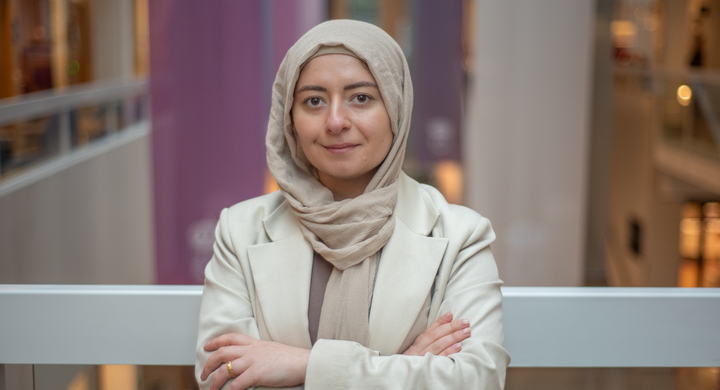
From Swedish Law to International Perspectives
Leyla wanted to broaden her knowledge and explore opportunities to work in an international setting. She chose the Master's Programme in International Operational Law at the Swedish Defence University. The connection between legal advice and military decision-making has made a particularly strong impression on her.
What made you choose this particular programme?
– I was attracted by the opportunity to earn an LL.M. (Master of Laws) while deepening my legal knowledge in a more international field. Having previously studied law with a focus on the Swedish legal system, I wanted to broaden my perspective and explore opportunities to work on legal issues in an international context. The programme therefore felt like a natural next step in my academic development.
What expectations did you have before starting the programme?
– I expected the programme to be challenging and demanding, but I was still surprised by the pace and academic level right from the start.
– I particularly remember the feeling during the first course of barely being able to keep up with the discussions, while everyone else in the classroom seemed to understand exactly what the lecturer was talking about. It was quite an overwhelming start! But as the course progressed, I gradually began to see how everything fitted together and became increasingly confident in the subject. By the end of the course, I had not only gained new knowledge but also developed a completely different level of confidence in my ability to analyse and discuss legal issues in this field.
Legal advice in practice
– One of the highlights so far has been our war games, which took place at the end of the first course. We had the opportunity to act as legal advisers to military personnel and apply the legal knowledge we had acquired during the course.
– It was an incredibly valuable experience because, for the first time, I really got to see how theory could be put into practice. It clearly demonstrated how law is applied in military contexts and the importance it has in real-life situations. For me, it was one of the experiences that really brought everything together.
– What particularly stayed with me was the insight into how legal advice works in a military context. It is not necessarily about explaining every article of a convention or international treaty, but about translating legal rules into clear, practical advice in a specific situation.
– As legal advisers, our role is to explain the applicable legal framework and provide commanders with the information they need to make decisions. It is then the commander who makes the operational decision, for example whether or not to carry out an attack. This clear connection between law, legal advice and military decision-making made a strong impression on me.
Has the programme changed the way you see or think about anything?
– Absolutely! I have started to view conflicts and wars around the world from a much clearer legal perspective. When I follow news reports about ongoing conflicts, I now automatically reflect on questions of international law, such as how hostilities are conducted and whether the parties are complying with the international rules governing armed conflict.
– You simply develop a different perspective on what is happening in the world. Something you might previously have seen primarily as a political or military event also becomes a legal issue that you want to understand and analyse in greater depth.
What does a typical week of study look like for you?
– It varies quite a lot depending on the course. On some courses, we have had lectures from Monday to Friday, usually between 9 am and 4 pm, with seminars towards the end of the week. Other courses have had a more concentrated timetable, with teaching in the mornings and a final seminar at the end of the course.
– In addition to scheduled teaching, there is of course a considerable amount of independent study and preparation for seminars and assessments. And a little tip for future students: be prepared for written examinations! Two of the courses are assessed through in-person written examinations, so it is important to keep up with the work throughout the course.
What would you like to do after completing the programme?
– My goal is to work in an international setting where I can apply my legal knowledge to issues relating to international law and security. At the same time, I am also interested in opportunities to work in Swedish central government.
– What these different career paths have in common is my desire to do meaningful work, where law has a practical impact and where I can contribute to something greater. For me, it is important to feel that the work I do makes a difference.
Read more about the Master's Programme in International Operational Law
Page information
- Published:
- 2026-11-17
- Last updated:
- 2026-11-17