
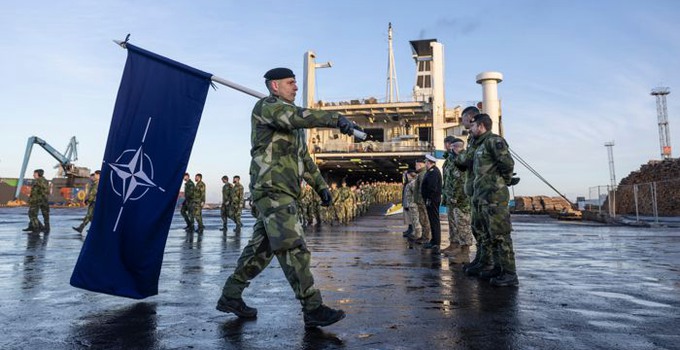
Photo: Amanda Gahm/ Försvarsmakten
Sweden and Finland's path to NATO membership
In the book NATO’s Northern Enlargement – Finland and Sweden’s Path to Membership, Magnus Christiansson and Tuomas Forsberg examine the accession processes of Sweden and Finland to NATO and what their membership means for the alliance.
“Finland and Sweden’s journeys into NATO were marked by paradoxes. The processes were led by traditionally NATO-sceptical Social Democratic parties in both countries, and although initiated for rational security reasons, they were also influenced by emotional factors,” says Magnus Christiansson, Senior Lecturer in War Studies at the Swedish Defence University, who co-authored the book with Tuomas Forsberg, Professor of International Relations at Tampere University in Finland.
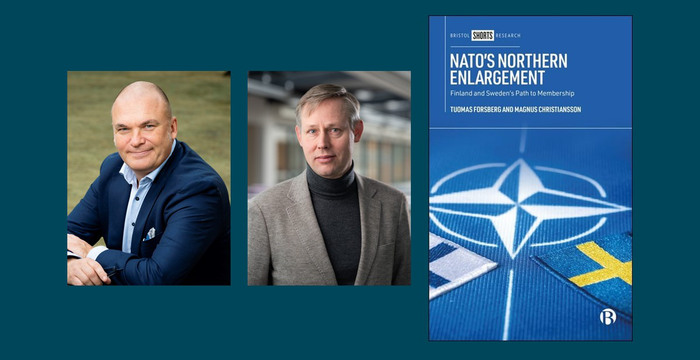
Tuomas Forsberg (to the left) and Magnus Christiansson.
The state of research on NATO enlargement
The book outlines the current state of research on NATO enlargement and includes empirical chapters on the paths taken by Finland and Sweden towards membership. It also explores what the accession means for the two countries and the implications of a new northern flank for the alliance as a whole.
“We simply wanted to produce a reasonably comprehensive book on a major strategic shift in the wake of the war in Ukraine,” says Christiansson.
Continuity and change in Nordic security
The Finnish and Swedish accessions represent both continuity and change.
“It was a significant shift to finally bid farewell to neutrality and Finlandisation, but it was also fully in line with the trajectory of security policy development since at least 1994,” Christiansson explains.
From the alliance’s perspective, paradoxes also emerged. The applicant countries initiated the process out of national security concerns, yet the enlargement affirmed a fundamental liberal principle within the transatlantic security system. The process was both fast and slow—rapid compared to other enlargements, yet slow given the security situation.
“The consequences are paradoxical too. The ratification process was good in that there was strong unity within the alliance, but also problematic, as individual countries used it to further their own strategic interests,” Christiansson adds.
Stability and tensions on NATO's new northern flank
For Russia, the enlargement was both a strategic setback and a predictable development: a significant shift in the strategic balance in the north, yet something long anticipated.
“Although much can still unfold on the new northern flank, Finland and Sweden’s membership in NATO brings both stabilisation and heightened tensions. There remain risks of confrontation and incidents, but within a more predictable framework,” says Christiansson.
“Perhaps the greatest and most ironic paradox is that the Nordic region may come to unite under the Stars and Stripes, just as Finland and Sweden joined at a time when the United States was fundamentally challenging the transatlantic bond,” he continues.
For students, researchers and the interested public
The book is aimed at students, scholars, and the general public interested in understanding Finland’s and Sweden’s NATO accession in comparison to previous rounds of enlargement.
“It also provides insight into the foreign policy decision-making in Finland, Sweden and NATO during the period 2022–2024, and analyses the implications for security in Northern Europe,” Christiansson concludes.
Publication
Magnus Christiansson and Thomas Forsberg (2025): NATO's Northern Enlargement – Finland and Sweden's Path to Membership, Bristol University Press
Page information
- Published:
- 2025-08-06
- Last updated:
- 2025-12-01