
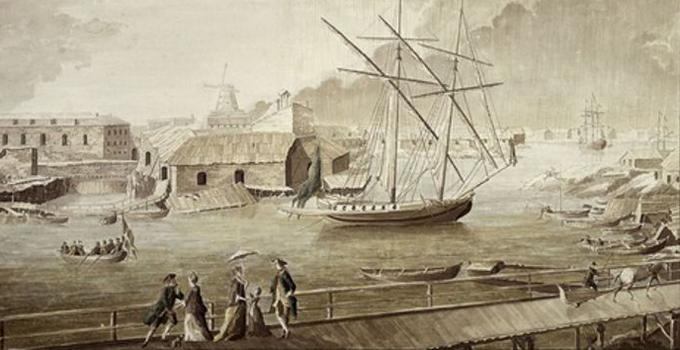
The Artillery Bay, Suomenlinna, Finland, by Adolf Geete, 1760. Wikimedia Commons.
War, trade and power in the Early Modern period
War in early modern Europe was not only fought on the battlefield, it was also organised, financed and supplied through extensive commercial networks. A new anthology highlights how this “business of war” developed in the Baltic Sea region between 1530 and 1765.
The Business of War in the Early Modern Baltic Sea Region, 1530–1765 brings together a series of case studies that explore how states, merchants and private actors collaborated to finance, supply, and sustain warfare. Four of the essays in the volume are written by researchers at the Swedish Defence university.
“The anthology examines how fiscal-military systems and military markets developed across Northern Europe over three centuries”, says Steve Murdoch, professor of military history at the Swedish Defence University, and one of the editors and contributors to the volume.

The anthology is published by Helsinki University Press (open access).
War as an economic system
The different essays highlight key dynamics such as logistics, contracting, and resource mobilization, offering insights into patterns that still resonate in the study of war and military organization.
“It shows how collaboration between states and private actors was essential to finance, supply and organise war”, he says.
In early modern Europe, war was one of the largest economic sectors. Frequent conflicts, growing armies and new technologies increased the demand for manpower, equipment and administrative expertise. Much of this was sourced through international networks of merchants and military entrepreneurs.
The Baltic Sea region in focus
Despite growing interest in the field, the field remains unevenly developed.
“Existing research has largely focused on the Mediterranean and Central-Western Europe, leaving Northern Europe and the Baltic Sea region comparatively underexplored”, says Steve Murdoch.
The anthology was conceived to address that imbalance by bringing together new research that situates the North within broader discussions of military enterprise and state formation.
New perspectives on military entrepreneurship
The volume provides the first sustained, comparative overview of military entrepreneurship and public–private cooperation in the Baltic Sea region. Drawing on new archival research and interdisciplinary perspectives, it demonstrates how Northern European states, particularly Sweden, including Finland, relied on complex commercial and manufacturing networks to support their military ambitions.
“By foregrounding these connections, the book not only fills a geographical gap in the literature but also refines our understanding of how war economies functioned beyond the better-studied regions of Europe”, says Steve Murdoch.
“For scholars, students, and professionals engaged in the military field, the volume encourages a critical engagement with the past as a way to better understand present challenges”, he continues.
Publication
The Business of War in the Early Modern Baltic Sea Region, 1530–1765 (open access), Helsinki University Press
Contributions from researchers in military history at the Swedish Defence University:
- The Financial Infrastructure of Warfare: Merchant Bankers, Bills of Exchange, and the Exchange Bank in 18th-Century Sweden, Peter Ericsson
- Private Enterprise and Commercial-Diplomatic Exchange: British Arms Supply and Sweden, 1654–1660, Adam Grimshaw (visiting researcher)
- Social Capital v The Fiscal-Military State: The Logistics and Supply of the Covenanting Army, 1633–1641, Steve Murdoch (and Alexia Grosjean)
- Intelligence, Security, and the Military Market in Sweden, 1538–1547, Martin Neuding Skoog
More about
Page information
- Published:
- 2026-05-04
- Last updated:
- 2026-05-07