
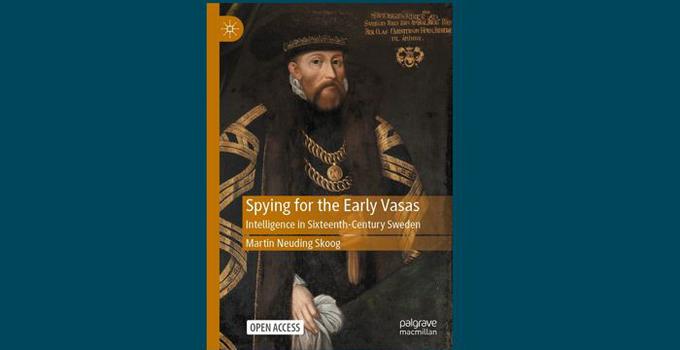
The book is published by Palgrave Macmillan as an open-access publication.
Sweden had extensive intelligence networks as early as the sixteenth century
Sweden developed sophisticated and extensive intelligence networks much earlier than has previously been recognised in research. This is demonstrated in a new book on intelligence organisation during the reigns of Gustav Vasa, Erik XIV and Johan III.
In Spying for the Early Vasas – Intelligence in Sixteenth-Century Sweden, Martin Neuding Skoog, Senior Lecturer in Military History, explains how intelligence activities became a central part of Swedish state-building as early as the sixteenth century. Through networks of spies, diplomats, merchants, soldiers, priests and peasants, the state gathered information on military threats, political plans and developments abroad.
“The research shows that the Swedish state conducted systematic and strategic intelligence activities already during the Vasa period, despite Sweden at the time being a relatively small and peripheral state in Europe”, says Martin Neuding Skoog.
The king personally directed intelligence work
One of the study’s most important findings is that the Swedish intelligence organisation differed from several other European great powers of the same period. In countries such as England and the Italian states, more centralised intelligence systems were developed, with dedicated spymasters and advanced secretariats.
In Sweden, however, the organisation was decentralised but closely tied to royal authority. Gustav Vasa personally took part in intelligence work, analysed reports and could even decide which disguises agents should use.
The intelligence networks were organised primarily through regional bailiffs, castle governors and military commanders. Important border strongholds such as Kalmar, Älvsborg, Viborg and later Reval (present-day Tallinn) developed into intelligence centres where information was collected and forwarded to the king.
Peasants and merchants were used as agents
The study also shows that intelligence work relied on a broad network of people from different social groups. Merchants, students, diplomats and soldiers were used to gather information during journeys abroad. Peasants living in border regions also played an important role, as they could cross borders without arousing suspicion.
“Institutions resembling today’s intelligence agencies did not yet exist. Instead, intelligence gathering was an integrated part of both the civil and military administration”, says Martin Neuding Skoog.
In some cases, outright espionage operations were carried out in which agents travelled disguised as horse traders or merchants, for example. Prisoners of war and defectors were regularly interrogated to obtain information about enemy plans and military strength. Surveillance and counter-intelligence also developed rapidly during this period.
The study, which is based on extensive research in Swedish and foreign archives, has identified around 500 individuals who in various ways participated in the Swedish intelligence organisation during the period.
Focus shifted eastwards
The book also shows how Sweden’s strategic interests changed during the sixteenth century. During Gustav Vasa’s reign, intelligence efforts were directed primarily towards Denmark and the German territories. From the middle of the century onwards, the focus increasingly shifted eastwards towards Livonia (present-day Baltic region) and Russia.
This eastern orientation enabled Sweden to establish an extensive intelligence network in the region even before Erik XIV’s expansion into the Baltic area. At the same time, Swedish agents operated across large parts of Europe.
Intelligence became part of state-building
According to the study, intelligence activities played an important role in Swedish foreign policy, military strategy and national security. Information was used to assess threats, monitor military build-ups and make decisions regarding war, diplomacy and alliances.
The findings also show how the need for information contributed to the development of state structures and strengthened royal authority during the Vasa period. Although Sweden lacked the more advanced institutions found in other European states, it nevertheless succeeded in creating an extensive and effective intelligence-gathering system.
“What makes the Swedish intelligence organisation remarkable is not primarily its technical sophistication, but rather its scale and the pragmatic and innovative use of networks and information”, says Martin Neuding Skoog.
Publication
Martin Neuding Skoog (2026): Spying for the Early Vasas - Intelligence in Sixteenth-Century Sweden (Open Access), Palgrave Macmillan
More about
Page information
- Published:
- 2026-05-12
- Last updated:
- 2026-05-12