
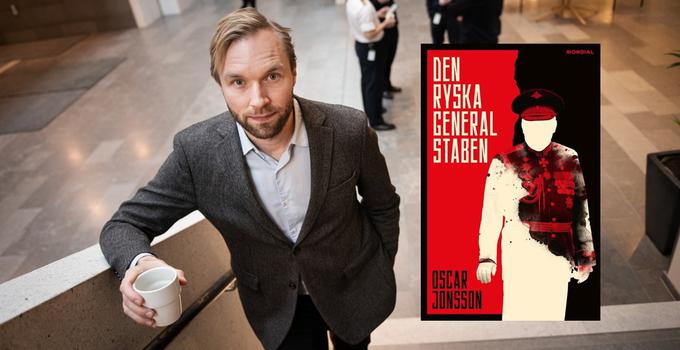
Oscar Jonsson is a researcher at the Department of War Studies at The Swedish Defence University. Photo: Anders G Warne
The role of the Russian General Staff in war and politics
How does the institution at the heart of Russia’s military leadership think? In his new book, The Russian General Staff, Oscar Jonsson, a researcher at the Swedish Defence University, examines the role of the General Staff in Russian warfare, military thought and politics.
When Russia launched its full-scale invasion of Ukraine in 2022, the Russian leadership expected a swift victory. Instead, the initial phase of the invasion was marked by several widely noted failures. This raises questions about how Russia’s military leadership plans and conducts war.
In his new book, Oscar Jonsson turns his attention to the Russian General Staff. It plays a central role in commanding the Russian Armed Forces and in preparing Russia for future wars.
“The General Staff is the most important military institution in Russia and is responsible for military command and strategic thinking. It also serves as the interface between the military and politics. The more you study the Russian military, the clearer the General Staff’s unique position becomes”, says Oscar Jonsson.
The General Staff constitutes an elite within the Russian military, with its own education and career paths. Despite its central position, it has received relatively little attention from researchers in the West. According to Oscar Jonsson, no book with a comparable focus has been published for around 20 years.
Military expertise has lost political influence
The book examines the General Staff from three perspectives: military command, the development of military theory, and its role as a political actor. One of its conclusions is that the General Staff’s political influence has declined.
“Previously, the General Staff was a political actor that influenced both domestic and foreign policy. Since around 2008, Putin has consolidated his control over the armed forces. This may seem contradictory, given that Russia’s military capabilities have grown considerably over the same period, but military expertise plays an increasingly limited role in Russian decision-making”, says Oscar Jonsson.
To examine how the General Staff functions, Oscar Jonsson has combined several types of source material. Among other things, he has studied Russian military publications, legislation and reforms of the military command structure, as well as research on Russian politics and relations between the political and military leadership.
The findings were then compared with experiences from wars fought by Russia and the Soviet Union, from the intervention in Afghanistan in 1979 to the full-scale invasion of Ukraine in 2022.
“By studying these wars, it is possible to see how the role of the General Staff has worked not only in theory but also in practice”, says Oscar Jonsson.
Knowledge that can contribute to understanding Russia
According to Oscar Jonsson, a deeper understanding of the Russian General Staff can help us understand how Russia may act in the future. This knowledge has direct implications for Swedish security.
“The better we understand the Russian Armed Forces, how they function and how they interact with politics, the better equipped we are to understand the choices Russia may make in the future. The book can also help senior officers understand their Russian counterparts, how they work and how they think”, says Oscar Jonsson.
Publication
The book is published in English by Georgetown University Press (2026): The Russian General Staff
It will also be published in Swedish (Mondial förlag) and will be available from 5 October 2026: Den ryska generalstaben
Book talk about the Russian General Staff
The book will be presented (in Swedish) at a launch at the Swedish Defence University on 14 October, where Oscar Jonsson and Major General (reserve officer) Gunnar Karlson will discuss the book. Read more and register by 12 October.
Page information
- Published:
- 2026-08-31
- Last updated:
- 2026-08-31