
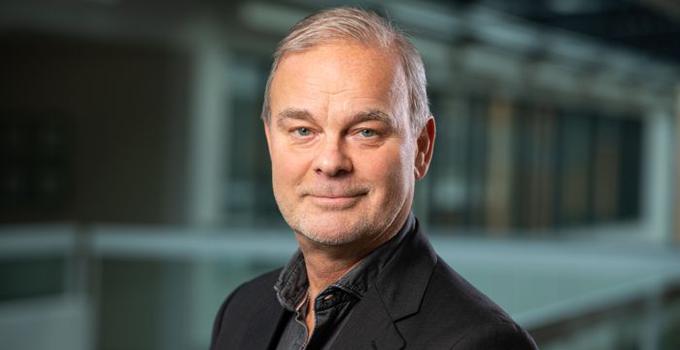
Photo: Anders G Warne
“We need to create exercises that actually lead to learning”
Erik Hedlund, Professor at the Department of Leadership and Command & Control, has in recent years focused his research on how civilian and military actors cooperate in exercises. His studies show that these exercises need fundamental change if they are to produce results.
Over the past five years, Erik Hedlund has followed cooperation exercises within total defence across the country. He is present throughout each exercise, observing how participants from various government agencies and the Swedish Armed Forces work together, often under time pressure. He sees clear patterns in how the set-up influences learning.
“People often gather between 100 and 200 individuals who do not know one another and give them a complex task to solve in a short period of time, without leadership or a shared method. My research clearly shows that this approach does not work”, he says.
The consequence is that the ability to improve cooperation fails to materialise, despite the intention to strengthen it.
A model that allows learning
To change this, civil defence areas in southern Sweden and Military Region South have developed a new model for cooperation exercises. It is based on each level working with tasks that are manageable and comprehensible.
“When the strategic, regional and local levels are given clear assignments, the focus changes entirely, and so does the learning”, he says.
The model works because it aligns closely with the participants’ actual competence, responsibilities and everyday reality.
“There has been a lack of knowledge and pedagogical structure for running the exercises in a better way. But when the right pedagogical conditions are in place and lessons are learned from previous experience, the chances of achieving the learning one is aiming for increase.”
Erik Hedlund argues that the method for cooperation needs to be scaled up and become more uniform across the country.
“Today, 290 municipalities and 21 counties are all coming up with their own methods. There is no common structure. I believe we are moving towards something more unified, but it takes time. With NATO membership, it becomes even more important to start from established structures and methods.”
Following up on leadership in crisis and war
The next research project he plans to take on in 2026 concerns the new programme Leadership for Decisive Action in Crisis and War (HLKK). It is a total-defence initiative developed by the Leadership Concepts Division at the Centre for Societal Security, together with ten government agencies. The aim of the programme is to strengthen managers’ ability to lead, make decisions and collaborate during crises and war. It is based on research on leadership under demanding conditions, combined with experiences from real crises and wars, including Ukraine. Between 100 and 150 programme iterations will be carried out over the coming years.
Erik Hedlund will follow participants for roughly six months after they have completed the programme to see what has happened in their organisations.
“They return home with an action plan for themselves and their organisation. It is important to follow up and see whether it actually leads to anything.”
He sees the project as an important step towards strengthening both leadership and the ability to collaborate nationally.
“We need to follow this over time. If the programme is to make a difference, we must understand what happens when the participants return home.”
Interest in pedagogy
Erik Hedlund’s path into research began after many years as a middle-school teacher. He has worked in compulsory education, at the European School in Luxembourg, and at the teacher-training programme in Stockholm. When he began studying pedagogy in the late 1990s, the door to the Swedish Defence University opened.
“My professor had a temporary post here and brought me along. That was in March 2000, and I’m still here.”
In 2004, he completed his PhD with a dissertation on the academisation of officer education. Since then, he has conducted research on cultural encounters in international missions and learning in military staff exercises. In recent years, civil-military cooperation has become an increasingly important field of research.
Curiosity as a driving force
Looking back on his 25 years at the Swedish Defence University, it is curiosity that Erik Hedlund highlights.
“I have never been afraid to move on and try something new. I have followed what has felt important and interesting. I am 67 and expect to work until 69, when one must retire.
“There is still much to be done, especially when it comes to cooperation. We must find a shared model if this is truly going to work.”
In brief
At the Swedish Defence University since: March 2000.
Current: Will begin follow-up research in spring 2026, in collaboration with the Swedish Civil Contingencies Agency (MSB), on the programme Leadership for Decisive Action in Crisis and War (HLKK).
When I'm free: I enjoy playing boules and often travel to Thailand, where I co-own a small beach bar on Koh Phangan.
Last book read: Oj, oj, Europa! En murvel upptäcker en kontinent by Staffan Heimerson.
Hidden talent: I am fairly good at cooking.
Happy to discuss: Societal developments and interesting travel destinations.
My driving force as a researcher: Curiosity and interest in people.
More about
Page information
- Published:
- 2025-12-04
- Last updated:
- 2025-12-04