
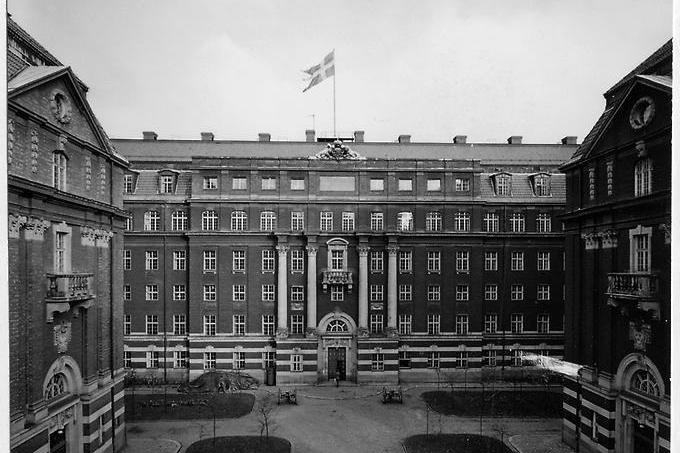
From artillery college to university
The Swedish Defence University has a long tradition of military education. Our roots can be traced back to the Artillery College at Marieberg, founded in 1818. Officer training programmes and other military education remain an important foundation of the University, but today we also educate civilian students at all academic levels.
The Napoleonic Wars exposed gaps in Swedish officers’ knowledge
Under the leadership of General Carl von Cardell, units from the Svea and Wendes Artillery Regiments took part successfully in the campaigns of 1813–1814 against Napoleon. During this period, artillery developed significantly, creating new opportunities for the advancement of tactics.
Upon returning home from the subsequent war against Norway, Cardell reported deficiencies in the theoretical knowledge of artillery officers. In April 1815, he was commissioned by the King to draw up a plan for an artillery college. The state purchased the Marieberg estate in 1817 as the site for the Higher Artillery College, whose mission was to provide education for artillery officers and others with the requisite prior qualifications.
In February 1818, the King approved regulations for the new institution, and Carl von Cardell became its first head.
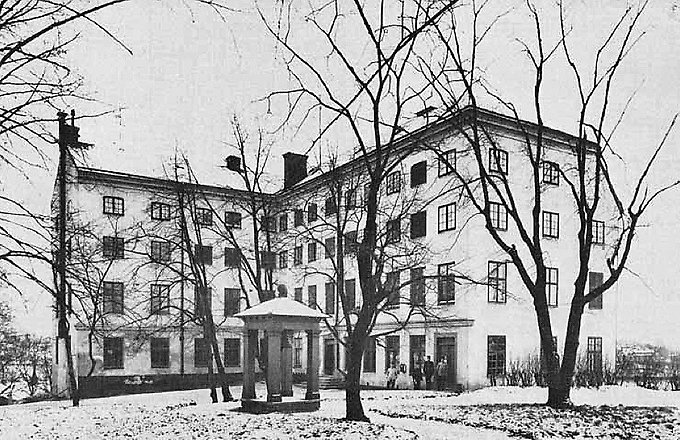
Artillery College Marieberg.
The General Staff is established
The Royal General Staff was established in 1816, but it was not until twelve years later that the King formally decreed that officers seeking to join the General Staff were required to pass a special examination: the General Staff Examination.
KTH emerges from the artillery college
As Sweden developed and industrialisation gathered pace in the mid-nineteenth century, a need arose for engineers with advanced technical education to support the expansion of the country’s infrastructure. At that time, the Higher Artillery College was the only institution in the kingdom providing such high-level technical training. In 1842, the Riksdag therefore decided to open the college to civilian students—future civil engineers.
Marieberg thus became not only an artillery and engineering officers’ college and a staff college, but also the country’s first and only institute of technology. After the Technological Institute had improved the quality of its education in 1867, the Riksdag decided that the civil engineering programme at Marieberg should be transferred there.
In total, 96 civil engineers were trained at Marieberg before the programme was transferred to the Technological Institute in 1870. In 1877, the institute changed its name to the Institute of Technology, later becoming the Royal Institute of Technology (KTH).
In 1866, education at Marieberg was divided into two tracks: an artillery and engineering officer programme, and a General Staff officer programme. The institution was then named the Royal Higher Artillery School – the Military Academy. After the General Staff was formally organised in 1873 and located in Schering Rosenhane’s palace on Riddarholmen, its first chief, Colonel Hugo Raab, sought to place responsibility for the training of future staff officers within the General Staff itself. In 1878, the General Staff programme at the Royal Higher Artillery School – the Military Academy was therefore separated from the Marieberg institution and continued as an independent staff college in the same building as the General Staff.
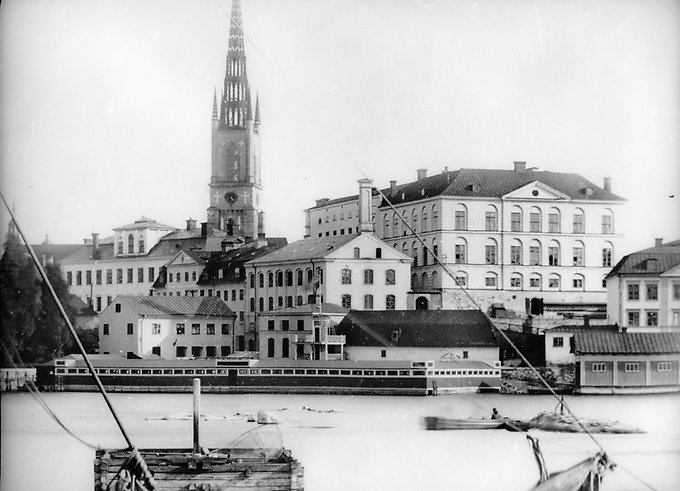
The General Staff was established in 1873 and located in Schering Rosenhane’s palace on Riddarholmen. The Royal Military College’s training for General Staff officers was also based at the same location.
Conscription is introduced
In 1901, the system of conscription was introduced, which led to a doubling of the demand for officer training at the Royal Military College (KHS), and a new cohort was admitted each year. As a result, premises in the “Old” Parliament building on Riddarholmen were also utilised. In 1908, the entire college was brought together in the former Army Administration building, Piperska Palace at Munkbrogatan 2 in Gamla Stan. In 1913, KHS, together with other occupants, moved into the first section of the new military staff building on Östermalmsgatan. In 1926, this initial building was expanded with a main building and an eastern wing. The General Staff and others moved into what came to be known as the “Grey Building”.
In 1951, higher technical education was transferred from the Artillery and Engineering College to the Royal Military College. The programmes at KHS then consisted of the original Staff Course, the Ordnance Engineering Course, the Engineering Course, and the Fortifications Course, the latter being joint across the branches of the armed forces.
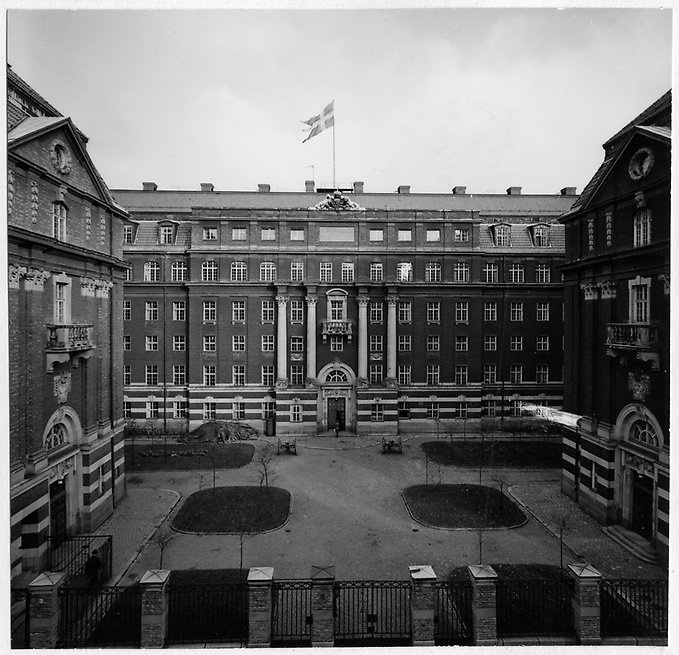
The Royal Military College.
The armed services establish their own colleges
Advanced education for naval officers was established with the founding of the Royal Naval Staff College in 1898. When the Coastal Artillery was created in 1902, the subject of coastal fortifications was introduced. Once compulsory general courses had been implemented, these were delivered in two tracks—the naval officer track and the coastal artillery officer track—while the advanced courses, namely the staff course and the technical course, were common to both.
The Swedish Air Force was established in 1926. During its first decade, officers were recruited from the Army and the Navy. The first officers to receive their basic training within the Air Force graduated from Ljungbyhed in 1939. The Air Force Staff College was also established in 1939, modelled on the Royal Naval Staff College. The college was organised into a general course, a staff course, and a technical course.
Experience from the Second World War clearly demonstrated the need to coordinate operations between army, naval, and air forces. As a result, the Defence Staff was reorganised in 1961 into an operational staff, and in 1966 the regional military commanders became operational commanders. This created a need for integrated advanced officer education, and in 1961 the three single-service staff colleges were therefore merged into a joint institution, the Royal Military Academy. For the first twenty years, it remained divided into service-specific tracks, but was later reorganised into operational, tactical, and technical programmes, among others. Training for administrative officers (intendents) was conducted until 1994 at the Administrative College in Östersund, and thereafter within the Military Academy under a management department.
The defence colleges merge into the Swedish Defence University
Experience from the Second World War also highlighted the need for total defence education for senior civilian and military officials. This was provided at the Royal National Defence College, established in 1953. Following the recommendations of the inquiry Defence Colleges, the Military Academy and the National Defence College were merged on 1 January 1997 to form the “new” Swedish Defence University. This laid the foundation for the ongoing development of academic education at the University.
As early as 1991, the then head of the Military Academy, Rear Admiral Claes Tornberg, and the Supreme Commander, General Bengt Gustafsson, introduced the idea of a total defence university. An initial step was the establishment of research at the Military Academy. The first professors were appointed in 1996. A doctoral programme under the Supreme Commander was introduced, although doctoral candidates were required to be enrolled and supervised at other universities.
In 2008, the Swedish Defence University was formally recognised as a higher education institution under the Higher Education Act and Ordinance, with the Ministry of Education as its governing authority. By then, the Officers’ Programme had become a three-year course leading to a professional degree of 180 credits, with the Swedish Defence University responsible for both programme design and delivery. This recognition granted the University the right to award degrees at undergraduate and master’s level. Following the development of the subject of War Studies and the opening of the University to civilian students in disciplines such as Political Science, the University applied in 2016 for the right to award degrees at both advanced and doctoral levels in the field of defence, crisis management, and security.
The Swedish Defence University gains degree-awarding powers at doctoral level
On 8 March 2018, the Government decided to extend the University’s degree-awarding powers, effective from 2 May of the same year. The Swedish Defence University thereby gained full authority to provide education and award degrees at all levels within the academic system.
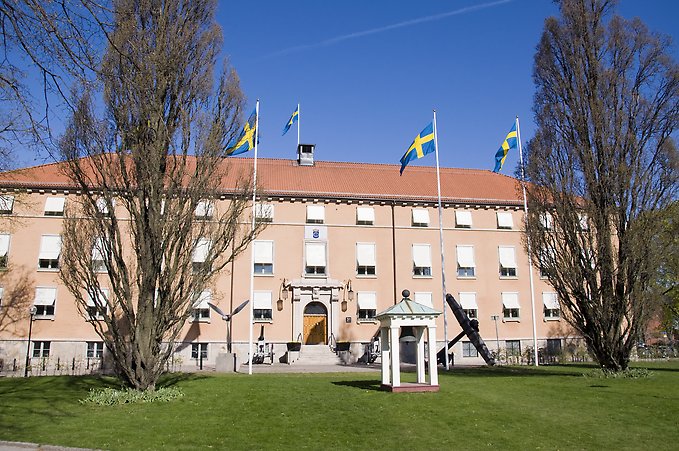
The Swedish Defence University today, at Drottning Kristinas väg 37 in Stockholm.