
The four levels of the quality system
The quality system should be understood as the whole of the systematic quality work.
SEDU's quality work is organised on four main levels
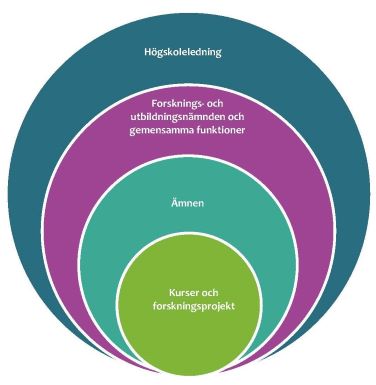
Responsible: Director of studies, examiner, course coordinator, project manager research, and other teachers, researchers and students
Course and programme coordinators, examiners, directors of studies and research project managers have a central role in quality work. By following common processes and regulations, systematics, equivalence and quality development are ensured. The university's regulations guarantee comparability and traceability over time, which enables follow-up and development. When course and programme evaluations comply with the regulations, both quality assurance and long-term improvement are strengthened.
Responsible: Head of Department, Chair of the Scientific Council and Scientific Council
The head of department is responsible for ensuring that the local and interdisciplinary quality work complies with the SEDU's regulations and quality system. A key document is the quality development plan, which is updated regularly and forms the basis for annual quality dialogues with SEDU management. The plan is based on follow-up and analysis of the activities to identify development needs and goals. Measures are prioritised with clear responsibility and followed up systematically.
The head of department is responsible for supporting an internal quality culture characterised by trust and good judgement, as well as ensuring common processes and equivalent processes for quality assurance and development in line with the university's quality system.
Important issues at subject level include, among other things, staffing, skills supply, strategic direction of education and research funding, securing student influence, close collaboration between education and research, and processes for establishing new education and applying for external research grants.
Subject councils and seminars are important for building a vibrant quality culture. Scientific councils are central preparatory and quality assurance bodies, while seminars and peer review play a key role in the Academy's quality work. The head of department is responsible for ensuring that the subject has a vibrant seminar culture and functioning processes for peer review.
The head of department is also responsible for ensuring that cross-cutting perspectives such as collaboration, sustainability, internationalisation and gender equality are integrated into quality work.
Research and Education Board
The Research and Education Board (FoUN) is an independent collegial body with overall responsibility for quality. FoUN is responsible for regulatory control of university-wide quality issues, quality assurance and decisions in certain cases, as well as review and evaluation of research and education. The Board is also a preparatory, proposing and advisory body to the University management.
Evaluation and review from independent and external perspectives are crucial to ensure that education and research meet established quality standards. It can also stimulate in-depth reflection. FoUN is responsible for conducting evaluations with expert external assessors. The results from the evaluations are then used in the quality development process.
The role and responsibilities of FoUN differ between education and research. When it comes to education, the board has a direct auditing role for the structure, implementation and quality. For research that is tested through established peer review processes, FoUN will instead work to provide good conditions for quality in research.
FoUN's evaluations of research and education
Responsible, management: Dean
Responsible, subject/programme: Head of department for the subject in question, or programme coordinator for military programmes.
Evaluations of research
Evaluations of education
Other university-wide functions and bodies
In addition to FoUN, there are a number of other university-wide functions and bodies that contribute to the Swedish Defence University's work on quality assurance and quality development.
Programme responsibility for military programmes is an assignment directly from the Vice-Chancellor. The programme management function is thus not subordinate to a subject management. Quality responsibility and operational responsibility for military programme training is a common concern for the programme director and the relevant subject managements. The programme manager focuses and coordinates the quality and development work within the programme from a holistic perspective. The programme director is also responsible for the cyclical quality development process in the form of the Vice-Chancellor's quality dialogues for education with management. The programme director is supported by a programme council.
The Employment Board is a preparatory and advisory body to the Vice-Chancellor with responsibility for quality assurance in employment and promotion matters.
The Research Ethics Council is a preparatory and advisory body on research ethics issues and research misconduct. The Council is also responsible for promoting the development of higher education in this area.
University Administrations services are responsible for management and operational support in quality work. Within the University Administration there are functions that are responsible for providing, among other things, infrastructure, student and research support, learning and information resources and study administration that appropriately meet the needs of the organisation, not least with regard to relevant quality aspects. The University Administration also provide support in matters relating to control and compliance.
Coordination of the doctoral education environment In addition to the chair of the Research and Education Board, the Dean is also responsible for coordinating the Swedish Defence University's doctoral education. The Dean follows up on quality assurance and quality development of doctoral education as a whole.
Training in teaching and learning in higher education In accordance with SUHF's recommendations, the Swedish University of Agricultural Sciences organises training in teaching and learning in higher education to ensure the quality of the design and implementation of the university's programmes.
Student, doctoral and alumni surveys The National Defence University regularly conducts student, doctoral and alumni surveys. The student and doctoral student surveys are conducted every two years, and the alumni surveys every three years. The results of the surveys are taken care of within the framework of the university's processes, and measures can also be included in the annual operational plan.
The University Management has the ultimate cohesive quality responsibility for the University's activities and thus also for the systematic quality assurance and quality development that is conducted. The quality culture must permeate the entire operation and the quality work is linked to SEDU's processes for operational management. The university management is supported by the university-wide functions to ensure systematics and continuous development.
The annual quality development cycles within subjects and interdisciplinary programmes are followed up through quality dialogues, where identified action needs can be incorporated into the SEDU's annual operational plan.
The Vice-Chancellor's Quality Dialogues for Education and Research
Responsible, management: Vice-Chancellor
Responsible, subject/programme: Head of department for the subject in question, and Programme Director for Military Programmes