
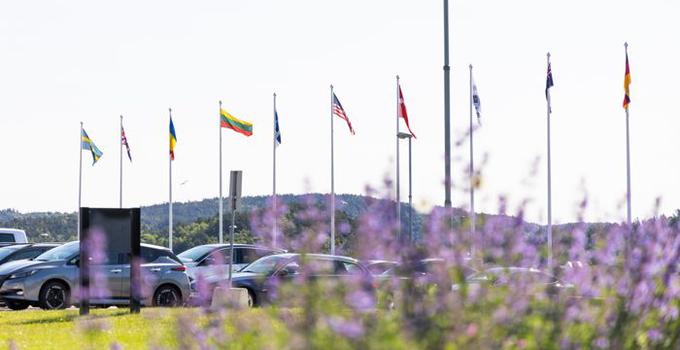
The exercise was conducted at Kjevik Air Base outside Kristiansand, Norway. Photo: Ella Hagen/ Forsvaret
Military staff exercise provides unique research opportunities
How can a well-functioning military staff be assembled quickly when its members come from different countries? That question was at the heart of the Comprehensive Shield staff exercise in Norway, in which researchers from the Swedish Defence University participated from 20 to 30 April.
During two weeks in April, around 300 participants from the Swedish Defence University and the Norwegian Defence University College gathered at Kjevik Air Base outside Kristiansand, Norway. The Swedish contingent included students from the Joint Advanced Command and Staff Programme and the Tactical Staff Course. The purpose of the exercise was to strengthen participants’ expertise in operational planning and cooperation within a NATO context.
One of the researchers on site was Stefan Annell, Senior Lecturer at the Department of Leadership and Command & Control at the Swedish Defence University. Together with Norwegian colleagues, he leads the research project Military Leadership Development in Theory and Practice, which examines how newly formed staff groups can rapidly develop into effective teams within higher-level NATO headquarters.
“The demands on the Swedish Armed Forces to quickly establish and operate within multinational headquarters have increased as a result of the deteriorating security situation and Sweden’s accession to NATO”, says Stefan Annell.
An important arena for research
Collecting data from real military environments is often difficult. Comprehensive Shield therefore provided an important opportunity for researchers to study how staff groups work together under conditions that closely resemble reality.
During the exercise, participants worked within a simulated higher-level NATO headquarters directing a multinational military operation. The research team collected data through digital surveys conducted before and during the exercise. Participants were asked questions about their backgrounds, motivation, and how cooperation within the headquarters developed from day to day.
In another part of the project, approximately half of the staff groups received a short, structured team building session on the first day of the exercise, while the remaining groups served as a control group. The purpose was to investigate whether such a team building activity could contribute to better collaboration and faster team development.
Research and education working together
One of the project’s objectives is to strengthen the link between research and education. Immediately after the exercise, participants received feedback in the form of personalised survey reports, allowing them to compare their own responses with those of the majority of the headquarters staff. Participants could then use these reports to support post-exercise reflection and their practical assignments. The collected data will also be available for student projects and for teaching quantitative research methods.
The project is also an important part of developing cooperation between the Swedish Defence University and the Norwegian Defence University College. It is being conducted in close collaboration with colleagues at the Norwegian Defence Command and Staff College, which forms part of the Norwegian Defence University College. The ambition is to further develop cooperation in both research and education.
Preparing tomorrow’s officers
During the autumn, the researchers will analyse the material collected during the exercise. The plan is to submit a scientific article before the end of the year.
Stefan Annell believes the research is important in helping to better prepare Swedish officers for work in international military headquarters.
“The increased threat environment and international cooperation place high demands on the Swedish Armed Forces and on the officers who will serve in headquarters in Sweden and abroad. We therefore need up-to-date research to support our educational programmes”, he says.
In the longer term, the plan is for more countries to participate in Comprehensive Shield and for the scenario to be relocated to the immediate region of Sweden and Norway.
“That would make both the exercise and the research even more relevant”, says Stefan Annell.
More about
Page information
- Published:
- 2026-06-02
- Last updated:
- 2026-06-02