
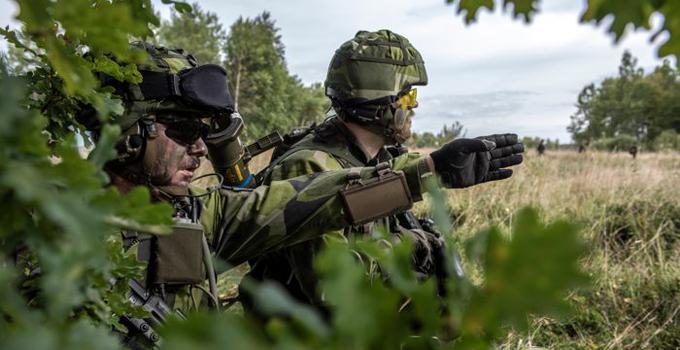
Photo: Antonia Sehlstedt/Försvarsmakten
Safety in military organisations involves more than what can be measured
Safety surveys focusing on security and safety are frequently used within the Swedish Armed Forces to identify risks before accidents occur. But how accurately do they reflect reality in a military organisation? In two new studies, Martin Schüler examines how safety is understood, measured and created within the Swedish military context.
Many of the methods used to measure safety climate have been developed for civilian organisations. The question is whether the results can be interpreted in the same way in organisations characterised by hierarchy, obedience and activities in which risk is a natural part of the work.
“Safety surveys can provide important information about how an organisation functions, but the results need to be interpreted in light of the context in which they are used. A question that may be understood in one way in a civilian organisation can have a completely different meaning in a military organisation”, says Martin Schüler, Major, Researcher and Military Teacher at the Swedish Defence University.
Safety climate within the Swedish Armed Forces
In a study published in the journal Methods in Psychology, he summarises almost ten years of research on safety climate within the Swedish Armed Forces. The findings show that established measurement instruments, such as the Nordic Safety Climate Questionnaire, can provide valuable insights in military organisations as well. At the same time, the study indicates that certain questions may be interpreted differently than in civilian settings. This is particularly true of questions concerning the ability to challenge decisions, speak up, or stop unsafe work. The study therefore presents a workflow for how safety surveys can be adapted, used and interpreted in hierarchical organisations.
Safety in practice
The second study, published in Safety Science, investigates how safety is created in day-to-day work. Through interviews with personnel from different parts of the Swedish Armed Forces, a broader picture emerges of what safety means in practice.
“Safety is not only about rules and procedures. It is also created through experience, judgement, relationships and trust between people. Much of what contributes to safety takes place in everyday work and is difficult to capture in a survey”, says Martin Schüler.
The study shows that the ability to speak up when something is wrong is often influenced by the situation, interpersonal relationships and how legitimate it is perceived to be to challenge a decision.
Different forms of knowledge are needed
Taken together, the two studies suggest that there is a difference between the safety that can be documented and measured, and the safety that is created in practice. To understand how safety functions in military organisations, both quantitative measurements and knowledge of how people manage risks, make decisions and cooperate in their daily work are therefore required.
“The research contributes new knowledge about how safety management can be developed within the Swedish Armed Forces and other organisations where safety must constantly be balanced against operational requirements”, says Martin Schüler.
Publications
Martin Schüler (2026): Safety climate questionnaire development in military organisations: A bounded narrative synthesis and validity-evidence workflow, Methods in Psychology, 14, 100256.
Martin Schüler (2026): Rethinking safety climate: safety as a situated, relational, and task-embedded practice, Safety Science, 203, 107326.
Both articles are published with open access.
More about
Page information
- Published:
- 2026-06-18
- Last updated:
- 2026-06-18