
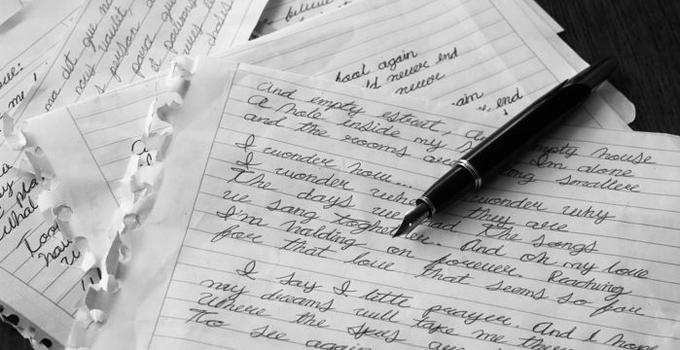
“This is not the first time I have worked with poetry in a research context. In previous research, I explored how poetry can help researchers remain human in empirical fieldwork. We see considerable potential in poetic expression, while also recognising that it can distort experiences”, says Yashar Mahmud. Photo: Unsplash
Poetry can build bridges between research and society
When research is communicated through poetry, it can evoke emotions, challenge established assumptions and offer new perspectives. This is demonstrated in a new study in which researchers from the Swedish Defence University and Stockholm University examined how poetry can be used to communicate research on deaf older adults’ experiences of health and social care.
The study explores how poetry can be used to communicate research on deaf older people’s experiences of elderly care services. The findings show that poetry can serve as a bridge between those who receive public services and those who make decisions about them.
The researchers drew on the experiences of deaf older adults receiving support through elderly care services. By transforming research findings into poetry and allowing civil servants, representatives of organisations and other stakeholders to engage with the poems, the researchers examined the reactions and insights that emerged.
Poetry evokes emotions
The study shows that poetry can help highlight experiences that might otherwise go unnoticed. Participants’ responses suggest that the poems evoked emotions, fostered understanding of other people’s perspectives and challenged established assumptions.
“Different audiences absorb knowledge in different ways. Our study shows that researchers may sometimes need to cross disciplinary boundaries in order to find new ways of communicating their research”, says Yashar Mahmud, Senior Lecturer at the Department of Leadership and Command & Control at the Swedish Defence University and one of the researchers behind the study.
Example of a poem from the project:
A world of 'silence' and signs
Enter our world
Might seem quiet, but
Don't be afraid
That you will be swayedBe patient and listen to us
Be curious and follow the signs
Be gentle and ready to rise
For we are full of surprise
Contributing to shared understanding and development
He argues that poetry should not replace established social science methods but rather complement them.
“Our findings show that poetry can help people understand others’ experiences in new ways and contribute to a shared understanding that does not always emerge through traditional forms of research communication.”
Poetry not only evokes emotions but can also contribute to learning and development.
“In other words, poetry and unconventional methods can be very powerful tools”, says Yashar Mahmud.
Part of a larger research project
The study forms part of a larger research project on deaf older adults’ experiences of elderly care and is based on interviews, observations and feedback from people working with issues relating to the care and support of deaf older adults.
“We wanted to explore whether poetry could open up new avenues for research communication. Traditional social science methods have their limitations, and by working across disciplinary boundaries we also wanted to increase understanding of the challenges faced by certain minority groups in society”, says Yashar Mahmud.
Publication
Tommy Jensen and Yashar Mahmud (2026): Poetry as research communication: internal exclusion of deaf older adults, Culture and Organization.
How the study was conducted
Interviews: Six deaf older adults were interviewed on a total of 17 occasions between 2022 and 2024. The interviews were conducted in Swedish Sign Language by deaf research assistants.
Observations: Yashar Mahmud followed two deaf assistant nurses during their work with deaf older adults over a six-month period, conducting observations in both residential care homes and private homes.
Poetry as research communication: Drawing on the interviews and observations, Yashar Mahmud wrote poems describing the situation and experiences of deaf older adults in elderly care services. The poems were presented to representatives of government agencies, municipalities, organisations and other stakeholders responsible for supporting and caring for deaf older adults. Their reactions and reflections were subsequently collected and analysed.
More about
Page information
- Published:
- 2026-06-08
- Last updated:
- 2026-06-10